Tag: inspiration
-
The Neighbors Next Door
By D. Ryan Lafferty
Jerry was a good man, well, as good a man as any, you might say. He took care of his home, his yard, that cherry-red mustang in the drive; all those little important things, like a good neighbor should. He was kind enough to the folks next door or the couples walking down his block. He would marvel often at how ridiculously some people would just strut right down the middle of the street as if they didn’t know any better, even with their dogs. He thought about the logistics of that whole situation, looked at the spotless sidewalks, scratched his head, and just like those oddball travelers, the thought meandered away.
Hendley Way, had always lived up to its name in his esteem, at least the name he called it as a private little joke. In Jerry’s mind it was always Heavenly Way and he’d chuckle to himself when the thought would visit him from time to time. The street was a postcard snapshot of the perfect suburban small town, a cookie cutter neighborhood, the kind Norman Rockwell would illustrate for The Saturday Evening Post. Not that anyone read an actual newspaper anymore, except for his neighbor on the left, let alone an evening edition. His Heavenly Way, reminiscent of that one sketch where the boy stares up at the policeman, his bindle on the floor under the swiveling stool, the smirking face of the sodajerk mouthing his cigarette, and not a soul paying any attention to the spaghetti and meatball special on the chalkboard. To Jerry, this neighborhood was like that, but real; real in the way that Jerry’s little slice of heaven would be paradise lost when his eyes met the virtue-signaling sign on the lawn next door or the banners and flags festooning the street.
He mumbled something unfriendly under his breath and stomped into the house, clicked on the TV to the constant cable news that he’d come to crave. It was always on whenever Jerry was home. He found himself missing it somehow, if the chattering pundits and red scrolling chyrons weren’t there, informing him of the freshest faults of the world. He didn’t even notice his conditioned reaction to the dramatic “dong” of the breaking news banner. Without fail, he’d look up from scrolling on his phone, or cooking dinner, robotically turning his head to catch the latest intel on the enemy within everything all around him. The TV kept Jerry steeped in a daily cycle of outrage and frustration. The glowing frame of the television set, a window to the sentries standing guard over moral society and sounding the alarm at a constant fever pitch, pinched off intermittently by endless ads for medicare benefits, hucksters pushing reverse mortgages, gold and an assortment of gibberish-named medications. Just then something caught his eye through the window. Even through the curtain he could make out a strange form floating along the curb, stop in its tracks and head back toward his front yard.
The mysterious man made his way from the sidewalk and up to Jerry’s door, a gentleman in a dark coat and wide-brimmed hat; a character ripped from the flicker of film noir. “Good evening friend. I couldn’t help notice the signs next door, such a shame, wouldn’t you say? What is this world coming to?” he hissed, and for a second the stranger seemed as if lost in some ancient memory of far better times, oh so long ago. “Here, try this, our only hope, to make this neighborhood great again.” He handed him what looked like a hideous gnome lawn decoration; a part-frog looking creature with a red hat and terra-cotta toned skin. Instead of a beard, its bulbous neck drooped and rested upon a protruding clay belly. “Here are three slips of parchment, simply write your command on this paper and feed it to gnolem…” he said with a knowing grin. “You expect me to believe that this absurd little toad, this gnome, will make my neighbors leave?” Jerry scoffed. “Yes, these are the old ways, and if you really want results, it’s simply a means to an end. And it’s not a gnome, a gnolem…,” “A whah?!” “A No-Lemm” the figure continued, “Dig a small hole in your backyard, write a command on a slip of this paper, tuck it inside, and our little friend will make it happen.” The incredulous look on Jerry’s face enraged the man, “Don’t be a COWARD!” he growled, leaning in too close for comfort. “Either you’re with us or against us. Do it, or you might as well join their side.” The ferocity in the voice, the look in his eyes made Jerry snatch the trinket out of impulse, “What does it cost?” he sighed. “Nothing serious, just your loyalty, that is all” he hissed. Jerry nodded as he closed the door and shivered from a sudden chill. He set the homely toad on the kitchen counter and looked out over his sink at the signs and banners from his neighbors’ yard. He scowled and scribbled, “remove the neighbors next door” naming them both on a single slip of paper, “and that incessant mongrel too.” He popped the folded paper into the mouth of the creature and tucked it in his garden, buried up to its nose in soil, then Jerry whistled merrily as he went up the stairs to bed.
He awoke in the morning to the familiar voices of those nuisance neighbors, calling their dog, “Misty! Here girl!” over and over again. Jerry rubbed the sleep from his eyes and peered out the bathroom window and looked into his garden. The toad had shifted. Inches of soil had shaken loose and it was facing toward the neighbors house, looking as if it were smiling. “Impossible!” he puffed and went about his day. Locking the door behind him, Jerry couldn’t help but notice the dark stranger visiting the house across the street. As he leered in that direction, a familiar face winced at him over steel-rimmed glasses. If looks could kill, this was a machete; brutal, sharp, and painful. “Pffft” Jerry scoffed, and drove to work.
It was 5:30 in the evening when Jerry’s mustang returned home to a crime scene. The yellow police tape draped over the sign-filled yard. A lump caught in his throat. “I hope nothing terrible has happened to them…” he said to himself. Slowly, it dawned on him, still slightly comatose from the mind-numbing doldrums of his workaday routine in the office, he raced to find the little clay toad. Gone. What had happened? He couldn’t resist stepping out into the back yard and leaning over the neighbors’ fence. Their deck was in shambles, a scene of terrible carnage, like something out of a horror movie. Holes dug under the fence led to tracks from his yard, leading toward the destruction. He could see just out of reach, a familiar scrap of paper containing the names of the recently departed. Jerry’s conscience or fear of getting caught got the better of him and he climbed up and over to snatch the evidence and take a closer look.
All was quiet as he stepped closer to the back door. The windchimes the only sound, tinkling like sleigh bells in the suffocating silence. They played an atonal tune, almost peaceful in the midst of such devastation. A rustling in the hedges made him nearly jump out of his skin. An orange neighborhood cat bounded out from the shrubs and into the front yard. A sigh of relief gave Jerry a momentary break in the mounting tension. “It’s just a coincidence, that’s all, I didn’t cause all this,” he laughed out of nerves. Another rustling in the bushes caused him to lean down, ready this time for the friendly feline. “Psst, psst, psst, here girl,” he said in a sing-song voice, but the shape that emerged wasn’t anything like a cat. Its skin made of clay and two piercing eyes burning with an ancient rage. A frog-like gnome that moved with the swiftness of a shadow and the strength of bear. Startled, Jerry fell backward, clamoring in the mud to gain his footing. In an instant the horrible fiend was upon him, clawing, biting, gnashing at him piece by piece, until it was over and in one final, desperate act, Jerry lifted his fist and smashed the creature as his breathing slowed and he was gone. Under his lifeless fist, another slip of paper could be seen within the fragments of pottery. The note read, “Jerry, with the mustang across the road, so rude to his neighbors next door.”
At that moment, a mysterious man strolled down the picture perfect street wearing his long black coat and wide brimmed hat, whistling a happy dirge to himself as the sun set on Jerry and his Heavenly Way. “Nothing ever changes,” the stranger chuckled to himself with a satisfied smile, “and as long as they hate each other, nothing ever will.”
Dr. D. Ryan Lafferty is a local Bordentown poet, writer, and the author-illustrator of children’s books. To see more of his writing, visit http://www.dryanlafferty.com.
-
Rush Hour
By D. Ryan Lafferty
It would have been Doomsday if not for the congestion at 9:15 on a bright Monday morning in northern New Jersey. Brake lights for miles on end burned in furious rage, bringing every single lane to a grinding halt. Just another day for the countless commuters wringing their watches, and hearts pounding in the sides of their heads, waiting. None of them knew that this was the scheduled day of reckoning, that Jim’s retirement was far closer than it appeared just this morning when he dragged himself out of bed and rushed through his shower, bickering his way to the door as his wife punctuated their goodbyes with a perfect slam the neighbors could hear down the block. He didn’t even have time for his bagel or coffee. What’s the hold up?! He bangs his fist on the steering wheel, swearing under his breath as his stomach gnaws in emptiness soured with stress. He turns up the chattering news on 1010WINS waiting for traffic and transit on the ones.
Jim was just one of thousands in the throng; hot headed, overworked and burdened beyond belief, just trying to make it into the office. According to the snarky reporter, it seems that some strange rider, some lunatic, was mowed down by an administrative assistant, emailing her boss and apologizing for running late, again. She’d only taken her eyes off the road for a second, she said, but now her car was totaled and the phone shattered and scattered across the piled up rubble spanning the highway. Some looney on horseback rolled the dice in a sea of speeding steel and asphalt and lost. Worst of all, he was riding in the left lane. He didn’t stand a chance.
It wasn’t always like this. When we first saved the date, times were simpler. Things had been so much easier back in the Bronze Age, no engines, only horse, buggy, maybe the odd chariot or elephant every now and then. But now, forget about it! 90 miles an hour and half of the drivers aren’t even looking. Self-propelled missiles with internal combustion engines, screaming toward destiny or at least a cubicle somewhere where they won’t stand out too much. We’ve got bills to pay and schedules to keep. There’s no time for the end of days. We’re way too busy and already running behind. What could a rational and sane person have to fear beyond this? Is there anything more harrowing, more dangerous than Route 80 traffic during rush hour? What possible torment could Dante ever imagine that doesn’t already exist here?
In related news, a second rider was detained in Newark International Airport and escorted quietly into a back room by the TSA. Apparently he had some explaining to do getting through the checkpoints at the gate. As anyone can tell you, there’s just no rushing this process and the appointed hour was drawing nearer every second. This minor inconvenience was turning out to be a major delay. Time always seems to somehow slow down when one is stuck in the airport. It’s almost as if it isn’t passing at all. Despite his protestations, this rider waits under the fluorescent tubes in a stark and barren gray-toned room. A modern take on purgatory almost as drab as those cubicles to which the aforementioned faithful were currently enroute. Stuck in between, he can only watch and wait as the hands of the clock in the corner tick steadily away.
Would you believe a third horseman was spotted around the same time, at least what was left of him after being creamed by a semi on the southern part of the Garden State Parkway. Squashed like a fat bug on a pickup truck windshield on some late August evening.
Death would have followed with them, but he was mugged using mass transit. In critical condition and on life support in the intensive care unit. The doctors say that it’s serious. It’s pretty touch and go at the moment and he might not make it through another day.
-
Auriga
(Reproduced here in the format of the original column from People Papers June 2024)
June is a time for the celebration of some of our greatest accomplishments. It is a time when we feel the most alive and the world is filled with sunshine and warmth. The living is easier in June and our sights are set on vacations, barbecues, rest and relaxation. I personally, never could rest much, it always seems like there is a little voice in the back of my mind telling me to get up and get back to work, or as Chaucer would say, “…that time and tide wait for no man.” That little voice was the inspiration for this month’s crumb, “Auriga.” Enjoy!
Auriga
In ancient Rome, leaders and war heroes were honored in large ceremonies, celebrations called triumphs, decreed by the senate. There, the crowds would cheer as Duces and Caesars paraded through the streets, greeting the throng. The leaders were driven in stately chariots, enrobed in bronze, faces and arms painted to meet the masses. Within the chariot, it was customary for the senate to appoint a slave to stand behind the hero; there to lift a crown of laurels above the victor’s head like a divine halo.
These men, these slaves, were curiously called auriga, a common name for a chariot driver in the races, and sometimes an everyday driver, a chauffeur to the elite. While in the throes of celebrity and fame, the auriga would whisper constantly in the ear of the celebrant, “memento mori [Remember you are mortal] – “Memento homo [Remember you are only a man],” over and over again. Some say it was the senate’s way of keeping the victors from losing themselves in the moment, the drink, and exaltation, while others chalk it up to maintaining modesty in the eyes of the gods, either way, it’s solid advice all around.
Perhaps their title was given on this occasion since they were driving the better angels of the Dux, reigning in their pride and worst impulses, moderating their ego and spurring on their humility. Even our own modern instincts are to get carried away with ourselves, so often letting our momentary victories go straight to our heads, resting on our laurels, awash in creature comforts of the lives we’ve won. In my mind, whenever I finish some great accomplishment or strike another mundane item from my to-do list, I hear whispers reminding me of the brevity of this life; the ongoing race of the chariots, the fleeing nature of time [tempus fugit]. Celebration is as essential as the grace in which we take part, the notion of a good sport, magnanimous in victory, and humble in acclaim. These seem somehow more important now, that the road has run longer, and the starting line, the origin, so very distant behind is lost in memory.
Wisdom often comes from the strangest places. Ancient gossip of pomp and circumstance is as good as any, I suppose. Incidentally the traditional title of the auriga, those chariot drivers I mentioned earlier, were tied to their reigns by the waist and often ripped from the wreckage, dragging behind two horses. They carried a curved dagger slipped into their waistbands to cut themselves loose from the doomed chariot. I’ll leave the reader here to wade through the rich symbolism and implications with a gentle whisper, “Yes, [carpe diem], seize the day, but [memento mori], remember you are mortal, remember that one day you will die.”by D. Ryan Lafferty
Note. Originally published in the People Papers column, Literary Crumbs, June, 2024.
-
Wabi-Sabi
It was only a couple of years ago, when my first gray hairs started to appear. A novelty at first and then an uneasy sense of dread. The latest sign of aging, of coming undone, cresting that hill, just after receiving those tacky greeting cards, reminiscent of a cartoon funeral, sitting next to my birthday cake. The type of cards that arrive in black envelopes, their faces emblazoned with the mantra, “Lordy, lordy, look who’s forty!” (My brother thought it was pretty funny then, he probably still does). For me, the process of aging was something that I quietly enjoyed witnessing. It is, indeed, better than the alternative, as I am so frequently reminded in casual conversation. The gray was only another stop on the path, the newest chip added to a mosaic of habits, scars, and blemishes, collected along the way. I have always taken delight in the unique characteristics of the world. The subtle imperfections in the sublime as it were. It offers a certain character, a handhold to grab onto, a means of connection.
There is an ancient Japanese philosophy tied to the aesthetics of the world known as Wabi-Sabi. It may sound funny to the Western ear, but this combination of contrasting principles aptly captures my feelings toward the people and objects that weather the ravages of time. There is a subtle beauty in watching the world wear and mold individuals under her harsh climes. This philosophy emphasizes three fundamental truths about the world: that nothing is ever finished, nothing is ever perfect, and nothing is truly permanent. Architects often play upon this juxtaposition, accentuating the old within the new. In Pittsburgh, I marveled at the artistry of marrying the aging brick foundations and steel appointments from the last century with the clean look of contemporary building designs, almost framing them in modern glass. It told a silent story of what had come before, a personal history of the locale. Instead of plastering over the chipped and worn components, they were prominently on display, distinguishing a unique past, and indeed, identity.
The two contrasting ideas in Wabi-Sabi are very different from each other, but combine in a nearly poetic way. Wabi, a concept which originally expressed a kind of mourning for a wish or goal, unfulfilled; a sadness resulting from a shattered dream. It would take on a more comforting sense of gratitude or spiritual abundance for having less and making the most of what one currently possesses rather than always looking for more. Even being thankful for some dreams that never came true. Then there is Sabi, an expression of beauty which is revealed over time. A continuation of the inner life of a person or object which remains after all the excess is stripped away. Like seeing the individual emerge in childhood, and last through old age with those unmistakable personal traits. These dueling ideas combine to capture what antique hunters have known all along, the value lies in the patina. Collectors cherish the original paint, the grime, and the oxidation, these are the signs of life, repeated use, and care. Even the pieces which are broken hold sentimental value when lovingly restored.
I recall my grandmother’s footstool, a squat little thing, maybe six inches tall and tenderly upholstered in crushed velvet, its nubby legs repeatedly broken then glued back into place. It came with her everywhere that she went. I remembered Grandma’s countless visits, sitting by her tiny red shoes and listening to old stories from a time so long before me that it seemed a fable, a fairytale in my imagination. Her footstool was such an ordinary object, repaired with so much love, it is impossible to consider throwing such a family heirloom away. Come to think of it, this reminds me of the Japanese pottery pieces so often associated with the philosophy of Wabi-Sabi, the repaired cups, pots, and bowls, known as Kintsugi.
Maybe you’ve seen them? Those small Japanese bowls, beautifully glazed, and perfectly shaped to handle the proper portion of an ancient strain of rice or flowery fragrant tea. Pottery, seemingly timeless in our modern world. In the darkness of the cupboard it could be easy to miss the lightning strike of gold running down the side, starting from the lip and spidering down to its base. These pieces of pottery were so well loved, that once they were dropped and broken, they were painstakingly mended using red lacquer and then dusted with gold powder to accentuate the places where the formerly perfect roundness and shine were disturbed. The process stems from practicality and a certain romantic perspective on the beauty of repair. The notion of a gilded seam, binding together the fragments damaged from a devastating fall. The pieces collected and carefully reassembled to make the dish whole again, forever changed in an instant, one unguarded moment; shattered, then remade with lustrous appointments of gold.
The concept has become somewhat trendy these days with people smashing their brand new bowls just for the look of it, a sort of self-scarification for ceramics. I’ve even been held captive in an audience at the mercy of a well-intentioned young lady who spoke with the fervor of a religious zealot on the matter. She swore that handing her fellow missionaries shards of coffee cups was the most clever gift ever to have been conceived. The thought of having them glue together the cheap mugs she’d bought as welcome gifts received more than a few eyerolls in the congregation. This was her icebreaker. I have a slight feeling that she may have missed the point.
It’s funny, I’ve known several people who’ve done the same thing in their own lives. Scars for scars’ sake, perhaps as a means of camouflage, covering those which truly hurt the most. So often we hide our imperfections from others, but we cannot lose sight that in this metaphor we are the valuable item (that which is cherished and loved). We are scarred and sometimes broken. We must care enough to repair the pieces and emphasize those life-shattering moments which have brought us this far, that have revealed our inner strength and our beauty. Embrace your flaws and accentuate your repairs. Make them golden and handle them with care for they tell your story, even your gray hair.
by D. Ryan Lafferty
Note. Originally published in the People Papers column, Literary Crumbs, July 2023.
-
All That We Will Leave
Be mindful of the things you do, be careful what you say.
Life is meant to be enjoyed and age the price we pay.Imagine it all ended; in fact one day it will.
Would the things that keep you up at night even matter still?The fire of time is greedy, consuming all it sees…
It gobbles up your hopes and plans then burns away your dreams.A warning now for all to hear, a sign for all to see…
The things we do and say today are all that we will leave.by D. Ryan Lafferty
-
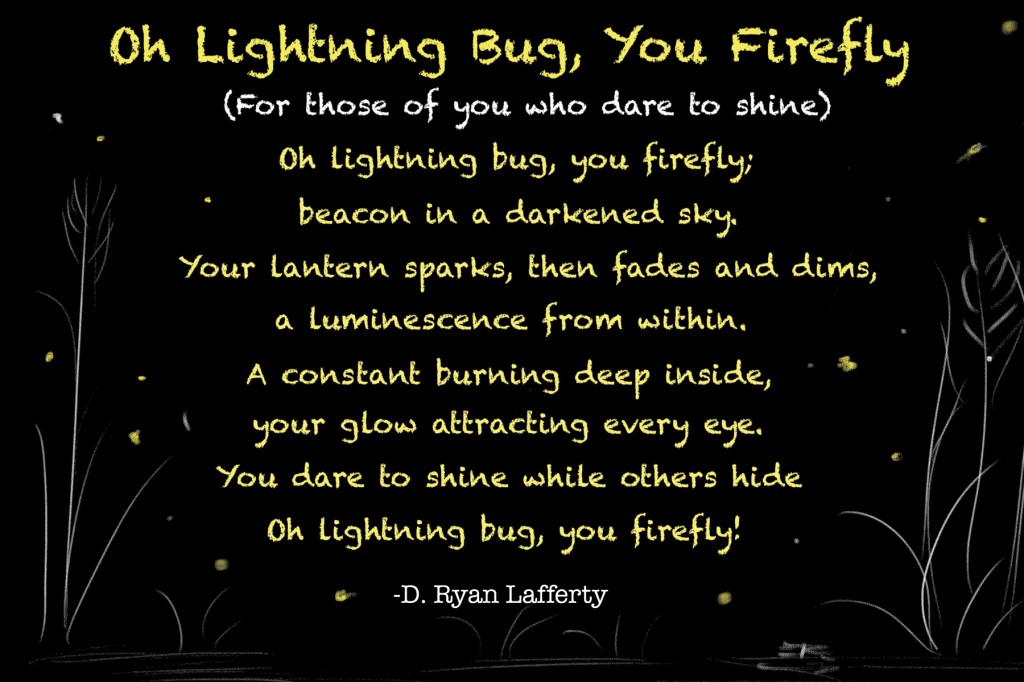
Oh Lightning Bug, You Firefly
(For those of you who dare to shine)
Oh lightning bug, you firefly;
beacon in a darkened sky.Your lantern sparks, then fades and dims,
a luminescence from within.A constant burning deep inside,
your glow attracting every eye.You dare to shine while others hide.
Oh lightning bug, you firefly.By D. Ryan Lafferty
DartanionPress.com
 Literary Crumbs: Poems & Short Stories to Savor by D. Ryan Lafferty